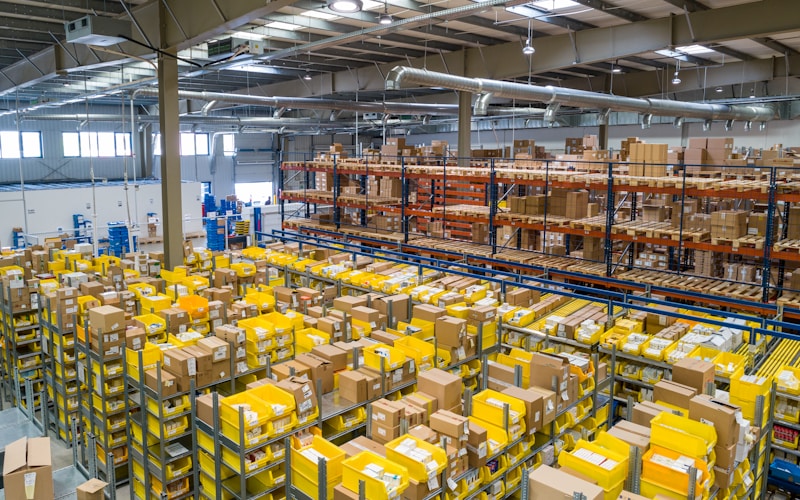
The 4PL vs 3PL question, extended to all four logistics models, comes down to one variable: how much of your supply chain you hand to outside partners. In a 1PL you do everything, in a 2PL you hire carriers, in a 3PL you outsource execution, and in a 4PL you outsource the orchestration of the whole network.
Picking the wrong rung on that ladder is expensive in both directions. Outsource too little and your senior team spends its week chasing carriers. Outsource too much too early and you pay a management layer to coordinate complexity you do not have yet. This guide compares all four models in one table, profiles each honestly, and closes with a growth-stage framework you can apply to your own operation, including the case that matters most to our readers: an international brand entering the U.S. market.
What Do 1PL, 2PL, 3PL, and 4PL Mean?
The numbers count how many parties stand between your goods and their destination. A 1PL moves its own freight. A 2PL is an asset-based carrier you hire. A 3PL executes warehousing and fulfillment as a service. A 4PL manages the entire chain, including the 3PLs and carriers inside it, as your single accountable partner.
The progression is historical as well as logical. Manufacturers started with their own trucks, then hired carriers, then outsourced warehouses, and eventually outsourced the coordination itself. Each step trades control for focus, and each step has a distinct buyer. What matters is that the models stack rather than replace each other: a 4PL network contains 3PLs, which in turn buy capacity from 2PL carriers. You are not choosing a technology; you are choosing which layer of the stack your own team operates.
4PL vs 3PL vs 2PL vs 1PL at a Glance
One table, four models, the differences that actually drive decisions:
| Model | Who owns what | Best for | Typical cost structure |
|---|---|---|---|
| 1PL | You own trucks, warehouses, staff, and systems | Local businesses; manufacturers with dense, stable delivery routes | Fixed: fleet, facilities, payroll, insurance |
| 2PL | Carriers own transport assets; you own warehousing and coordination | Companies with steady point-to-point freight and in-house ops teams | Per-shipment carrier rates plus your fixed warehouse costs |
| 3PL | The 3PL owns facilities and equipment; you own strategy and vendor coordination | Brands scaling e-commerce or retail in one country, one or two channels | Activity-based: storage per pallet, pick-and-pack per order, freight per shipment |
| 4PL | The 4PL owns the orchestration layer: vendor contracts, integrations, planning | Multi-channel and international brands, especially entering the U.S. | Management fee, cost-plus, or gain-share layered on executed costs |
Keep the table honest with two footnotes. First, hybrid setups are normal: plenty of brands run a 3PL for e-commerce while shipping wholesale freight directly with 2PL carriers. Second, the labels describe relationships, not company types. The same provider can act as a 3PL for one client and a 4PL for another, depending on who holds the coordination.
The Four Logistics Models Explained
1PL: First-Party Logistics
A 1PL operation handles logistics entirely in-house: your goods, your trucks, your warehouse, your people. A bakery delivering to local cafes on its own van is a 1PL, and so is a furniture manufacturer running its own regional fleet.
The verdict on 1PL is simple: unbeatable control, brutal economics at scale. Every truck, dock, and dispatcher is a fixed cost you carry through slow seasons, and every capability, from routing software to safety compliance, is yours to build and maintain. It survives where routes are dense, volumes are predictable, and delivery is part of the product experience. For a brand shipping parcels across a continent, it stopped making sense decades ago.
2PL: Second-Party Logistics
A 2PL is an asset-based carrier: an ocean line, a railroad, a trucking company, or a parcel network like UPS or FedEx. You hand them freight; they move it between two points. Warehousing, inventory, and coordination remain your job.
Practically every shipper uses 2PLs, since even the largest 3PLs buy underlying capacity from carriers. The question is whether 2PL relationships are your primary logistics model. Managing carriers directly earns you contract rates and control over service selection, but it also means your team owns rate negotiations, capacity crunches, claims, and the annual bid cycle. That overhead is tolerable for steady lane-based freight and punishing for fast-growing parcel volume across regions.
One boundary worth marking: a freight broker or forwarder that arranges transport without owning assets sits between 2PL and 3PL. If a provider only books capacity on your behalf, you still own the warehousing and the coordination, so functionally you are running a 2PL model with an agent attached. The label matters less than the question of who carries the coordination load, and in every 2PL variant, that is still you.
3PL: Third-Party Logistics
A 3PL executes logistics functions as a service from assets it operates: receiving your inventory, storing it, picking and packing orders, shipping them, and processing returns. You keep strategy, demand planning, and vendor coordination in-house.
This is the mainstream model of modern commerce, and the numbers show it. According to Armstrong & Associates' 2026 research, 94% of domestic Fortune 500 companies work with at least one 3PL, up from 46% in 2001, and U.S. 3PL revenues reached an estimated 424.3 billion dollars in 2025. Globally, Grand View Research values the third-party logistics market at about 1.26 trillion dollars in 2025. Momentum has not slowed: in the 30th annual Third-Party Logistics Study from Penn State, NTT DATA, and Penske Logistics, 81% of shippers reported increasing their use of outsourced logistics.
A 3PL converts fixed logistics costs into variable ones and buys you professional execution without capital. Its limit is scope: each 3PL optimizes its own four walls. The moment you add a second warehouse, a third marketplace, or an import lane, you become the integrator, stitching together providers that do not talk to each other. That coordination role is precisely what the fourth model outsources.
4PL: Fourth-Party Logistics
A 4PL takes responsibility for your supply chain as a system. It designs the network, selects and manages the 3PLs and carriers, integrates every system into one data spine, runs demand and inventory planning, and reports to you as a single accountable partner. Gartner formalized the category in 2025 with its first Magic Quadrant for fourth-party logistics, defining a 4PL as a provider that manages the design, build, run, and orchestration of an end-to-end logistics network.
Adoption is further along than most people assume. In Gartner's 2026 Logistics and External Manufacturing Outsourcing Trends Survey of nearly 220 supply chain leaders, 42% already outsourced to a 4PL and another 35% planned to within two years. The market is still young relative to 3PL, at 86.2 billion dollars in 2025 per Global Market Insights, but that gap is the point: orchestration outsourcing today looks like execution outsourcing did two decades ago.
The honest trade-offs: you operate at one remove from execution, you concentrate risk in a single partner, and exit takes planning because the 4PL holds your vendor contracts and integrations. A fuller treatment of the model is in our guide to what 4PL is and how it works.
4PL vs 3PL: What Actually Changes When You Move Up?
Moving from 3PL to 4PL changes what you buy. From a 3PL you buy execution: storage, labor, and shipping, priced per activity, with your team coordinating everything around it. From a 4PL you buy outcomes: an orchestrated network with one contract, one data picture, and one team answerable for end-to-end performance.
Day to day, the shift shows up in three places:
- Who manages vendors. Under 3PL, your team runs the freight forwarder, the customs broker, the warehouses, and the parcel accounts. Under 4PL, the partner runs them through a dedicated vendor management function, and you review scorecards instead of chasing emails.
- Who owns the data spine. Under 3PL, integration between your channels and providers is your project. Under 4PL, the partner maintains the connections and gives you one view of orders, inventory, and shipments. This matters because technology is the sore spot of outsourcing: in the 2026 Third-Party Logistics Study, 93% of shippers called IT capability a necessary element of provider expertise, while only 54% were satisfied with their providers' IT.
- Who plans. Under 3PL, forecasting and replenishment stay with you. Under 4PL, planning is part of the service, informed by data across the whole network.
A hiring analogy keeps it concrete: a 3PL is a skilled employee who executes a function well. A 4PL is the operations director who hires the employees, builds the process, and owns the number. You would not hire a director to do one person's job, and you should not staff a five-vendor network with no one directing it.
The corollary is that moving up too early is a real mistake, not a hypothetical one. A single-channel brand shipping modest domestic volume gains little from orchestration, because there is nothing to orchestrate; the 4PL fee would simply raise per-order cost. Treat the move as you would a director hire: justified by the size of the team being directed, not by ambition alone.
What Does Each Model Cost?
Each step up the ladder converts fixed costs into variable ones and adds a coordination layer someone must pay for, either in your payroll or in a provider's fee. A 1PL is nearly all fixed cost, a 2PL mixes carrier rates with your overhead, a 3PL is activity-priced, and a 4PL layers a management fee over executed costs.
Before comparing models, know what each invoice actually looks like:
- 1PL: capital and payroll. Trucks, leases, insurance, dispatchers, and maintenance, owed whether or not goods move.
- 2PL: per-shipment carrier rates, negotiated annually, plus the warehouse and staff costs you still carry.
- 3PL: activity pricing. Receiving per pallet, storage per pallet per month, pick-and-pack per order, packaging, and shipping, so cost scales with volume.
- 4PL: executed costs passed through or consolidated, plus an orchestration layer priced as a monthly management fee, cost-plus percentage, gain-share on documented savings, or a blended per-order rate.
The mistake most teams make is comparing those invoices line by line instead of comparing total cost of ownership. A fair comparison includes:
- Direct costs: rates, storage, and fulfillment fees on the invoice.
- Internal labor: the planners, coordinators, and managers each model requires you to employ. This is where 1PL and 2PL quietly get expensive, and where a 4PL fee buys back headcount.
- Failure costs: chargebacks, stockouts, expedited freight, and lost sales from coordination gaps. These land hardest on brands running multi-vendor networks without an integrator.
- Opportunity cost: senior time spent on logistics instead of product and growth.
Outsourced models tend to win that wider comparison as complexity grows. In the 2025 edition of the annual Third-Party Logistics Study, 75% of shippers said their providers helped reduce overall logistics costs, up from 66% a year earlier. The direction is consistent: the more moving parts, the better managed outsourcing performs against self-coordination.
Which Logistics Model Is Right for You?
Match the model to your operating complexity, judged by channels, countries, and vendor count rather than revenue alone.
- One market, low volume, learning fast: stay 1PL or 2PL. Ship from your own space with carrier accounts. Control and customer feedback matter more than efficiency here.
- Growing domestically, one or two channels: move to a 3PL. Variable-cost fulfillment and warehousing beats building your own, and your team can still coordinate one or two vendors.
- Multi-channel, multi-warehouse, one country: you are at the coordination ceiling. Either hire supply chain staff and integration tooling, or start evaluating a 4PL before service quality slips.
- International brand entering the U.S., three or more channels: go 4PL. You need an importer of record, customs brokerage, global freight, regional warehouses, marketplace compliance, and inventory planning to function as one system, run from a time zone your team does not sit in. Stacking that from abroad, vendor by vendor, is the slowest and riskiest way to enter the market. E-commerce already accounts for 16.4% of U.S. retail sales per Census Bureau 2025 data, and every channel you add multiplies the coordination load.
Three questions settle most cases. Where did your senior team lose the most hours last month: doing logistics, or coordinating it? How many logistics vendors do you manage today, and who is accountable when a handoff between two of them fails? And if you doubled channels next year, would your current setup absorb it? If the answers cluster around coordination pain, no single owner, and no, you have outgrown execution-only outsourcing.
How Pi-Commerce Helps You Skip the Vendor-Stacking Phase
Pi-Commerce operates as a U.S.-based 4PL for international brands, which means we sit at the top of the stack so you do not have to build it. We design your U.S. network, contract and manage the executing 3PLs and carriers, run integrated supply chain planning across channels, and consolidate every order, shipment, and inventory position into one weekly picture.
One worked example: an Asian consumer electronics brand came to us running the classic stack: a freight forwarder, a customs broker, one coastal 3PL, and direct parcel accounts, all managed by two people at headquarters overnight. We rebuilt it as an orchestrated network with two inland nodes, took over vendor management and replenishment, and onboarded Walmart and Target Plus alongside Amazon. Same product line, same team size at HQ, three times the channel footprint.
If you are deciding between hiring a 3PL, a second 3PL, or a 4PL for your U.S. expansion, talk to our team. We will map your vendor stack against each model and show you the total-cost math before you commit.


